
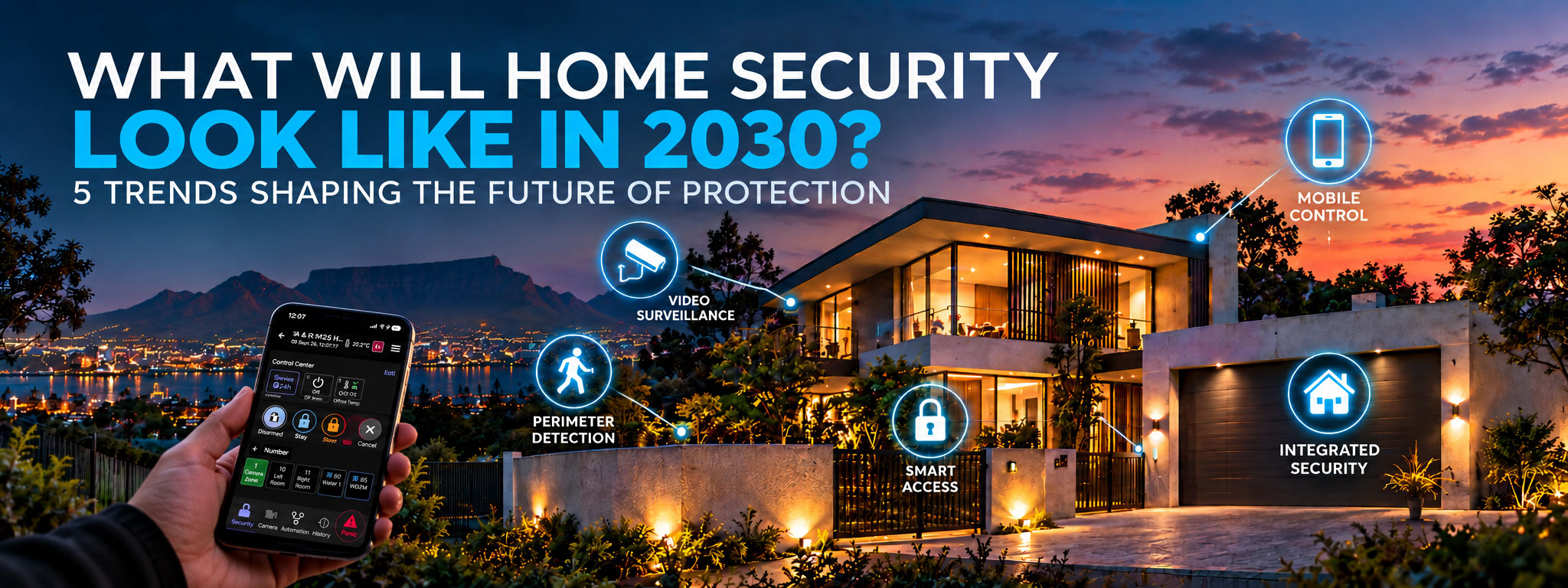
Home security has come a long way from the traditional alarm panel, a few magnetic contacts and a siren mounted outside the house.
Today, homeowners can remotely manage their security, receive instant notifications, view cameras from their smartphones and connect multiple technologies into a single security environment.
But this is only the beginning.
Over the next few years, advances in connectivity, artificial intelligence, video analytics, wireless technology and automation are likely to change the way people think about protecting their homes.
By 2030, the question may no longer be whether a property has an alarm system.
The question will be how intelligently its different layers of protection work together.
Here are five trends that are likely to shape the future of home security.
Traditional security systems are designed primarily to identify specific events: a door opens, a motion detector activates or an alarm zone is triggered.
The next generation of security will increasingly focus on understanding context.
Advances in artificial intelligence and analytics are already enabling security technologies to distinguish between different types of activity and reduce unnecessary alerts.
Instead of simply reporting that motion has been detected, increasingly sophisticated systems can help determine whether that activity is likely to represent a person, vehicle or another event.
This has an important implication for homeowners.
More information does not necessarily mean better security.
Better information does.
The future of security will therefore be about turning large amounts of data into useful information that allows homeowners, monitoring centres and security professionals to respond more effectively.
The days of security technologies operating completely independently are gradually disappearing.
Intrusion detection, CCTV, access control, intercoms, smart devices and remote monitoring can increasingly form part of a connected security environment.
This does not mean that every home will need dozens of interconnected devices.
Instead, the trend is towards creating systems where the technologies that matter can communicate and complement one another.
For example, an intrusion event could be supported by information from a camera, while a homeowner receives relevant information through a mobile application.
This creates a more complete picture of what is happening rather than relying on a single device or alert.
Solutions such as the Paradox M25 demonstrate this movement towards connected security, while modern video-security platforms are adding increasingly sophisticated analytics and integration capabilities.
The future will not necessarily belong to the company selling the most devices.
It will belong to the solutions that make those devices work better together.
The days of security technologies operating completely independently are gradually disappearing. Intrusion detection, CCTV, access control, intercoms, smart devices and remote monitoring can increasingly form part of a connected security environment.
This does not mean that every home will need dozens of interconnected devices. Instead, the trend is towards creating systems where the technologies that matter can communicate and complement one another.For example, an intrusion event could be supported by information from a camera, while a homeowner receives relevant information through a mobile application.
This creates a more complete picture of what is happening rather than relying on a single device or alert. Solutions such as the Paradox M25 demonstrate this movement towards connected security, while modern video-security platforms are adding increasingly sophisticated analytics and integration capabilities.
The future will not necessarily belong to the company selling the most devices. It will belong to the solutions that make those devices work better together.
The smartphone has already changed how people interact with their homes. It has become a remote control for banking, communication, entertainment, smart appliances and increasingly, security. That trend is unlikely to reverse.
By 2030, interacting with a security system remotely will feel less like an advanced feature and more like an expected part of the customer experience. Users will want to know what is happening at their property, receive relevant notifications and manage appropriate functions without needing to be physically next to the alarm panel.
Mobile applications such as BlueEye are an early example of this transition. The important shift, however, is not simply the ability to control a system from a phone. It is the expectation that security should be accessible, understandable and available wherever the user is.
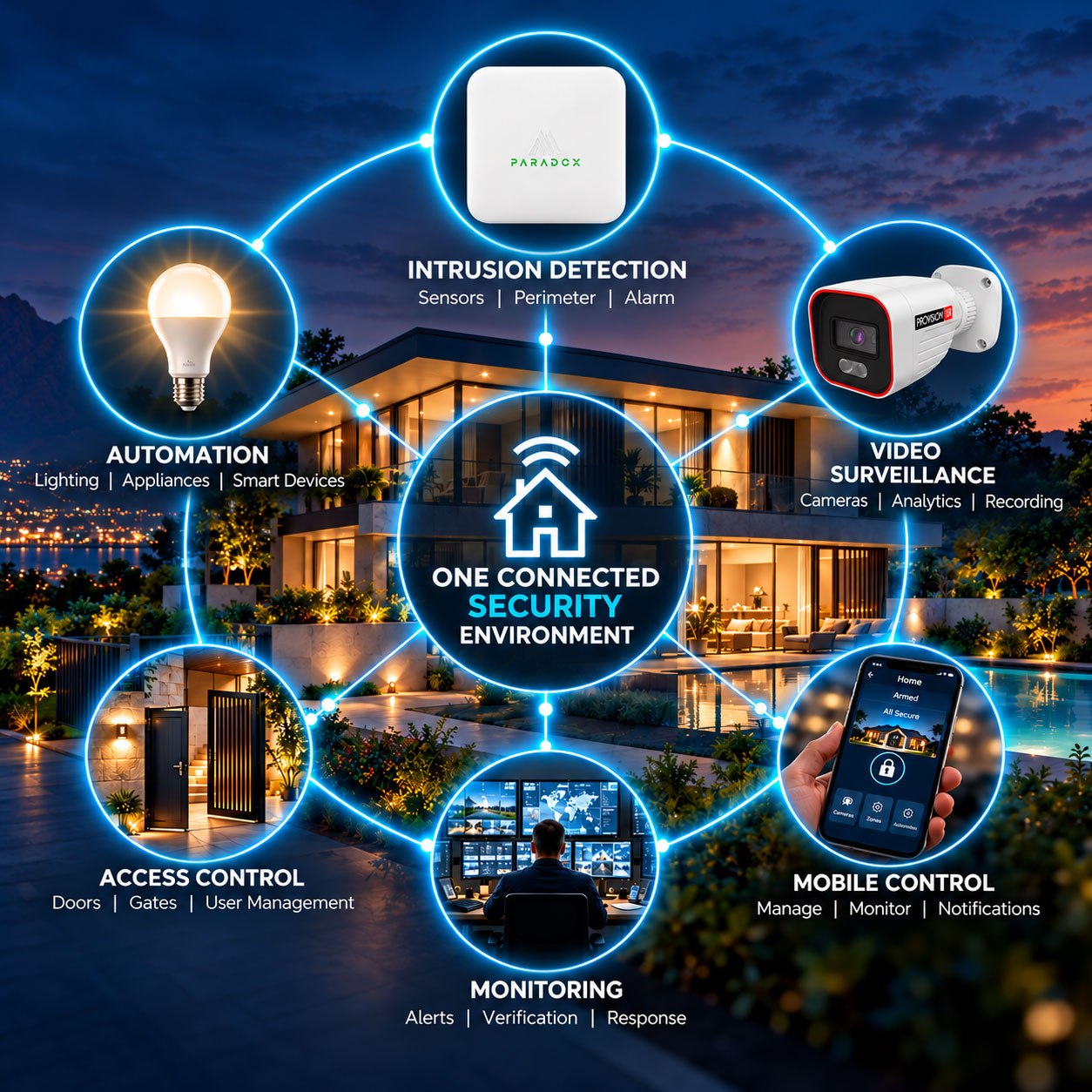
For many years, alarm systems and CCTV have been treated as separate categories. That distinction is becoming increasingly blurred. Intrusion detection can identify that something has happened. Video can provide visual context about what happened. Analytics can help interpret what the camera sees.
Combining these capabilities can create a much stronger security solution than relying on any one technology alone. This convergence is particularly significant for South Africa, where homeowners and businesses often require multiple layers of security. The future is likely to see greater integration between detection, verification and response.
Rather than simply receiving an alarm notification, users and monitoring professionals can increasingly have access to more information about the event itself. This can support faster and more informed decisions. For security professionals, this also creates an opportunity to design solutions around the entire security environment, rather than selling individual products in isolation.
A security system installed today needs to remain useful tomorrow. Homes change. Families change. Technology changes. Security requirements change. This makes adaptability one of the most important characteristics of future security systems.
Homeowners will increasingly look for solutions that can evolve as their needs change rather than requiring a completely new installation every few years. Wireless technology has an important role to play here because it can provide greater flexibility when expanding or adapting a system. Scalable platforms can also allow customers to start with the protection they need today and expand their security environment when circumstances change.
This is where professional system design becomes increasingly important. The best security solution will not necessarily be the one with the most features. It will be the one designed around the property's actual risks, the customer's requirements and the possibility of future expansion.
The future of home security is unlikely to be defined by one revolutionary device. Instead, it will be shaped by the gradual convergence of technologies that already exist. Artificial intelligence will make systems more capable of interpreting information. Connectivity will allow different security technologies to work together. Mobile applications will give users greater access and control. Video and intrusion detection will become increasingly integrated. And flexible platforms will allow security systems to evolve with the properties they protect. But there is an important principle that should not be lost in all this technology.
Smart security should make protection simpler, not more complicated. The purpose of technology is not to give homeowners more alerts, more devices or more information to manage. It is to give them greater confidence that their property is being protected and that, when something important happens, the right people have the right information to respond.
By 2030, the smartest security system may therefore not be the one that does the most. It may be the one that understands the environment, connects the right technologies, provides useful information and works quietly in the background. The future of home security is already taking shape.
For homeowners, installers and security professionals, the opportunity is to move beyond thinking about an alarm as a standalone product and start thinking about security as an intelligent, connected and evolving ecosystem.
That is the direction in which the industry is heading—and the companies that understand this shift today will be better prepared for the security needs of tomorrow. By combining trusted intrusion detection solutions, intelligent video surveillance, access control and connected technologies, Spectrum helps installers and security professionals build smarter, more integrated security solutions for the future.